Io: a volcanic plume beyond Earth
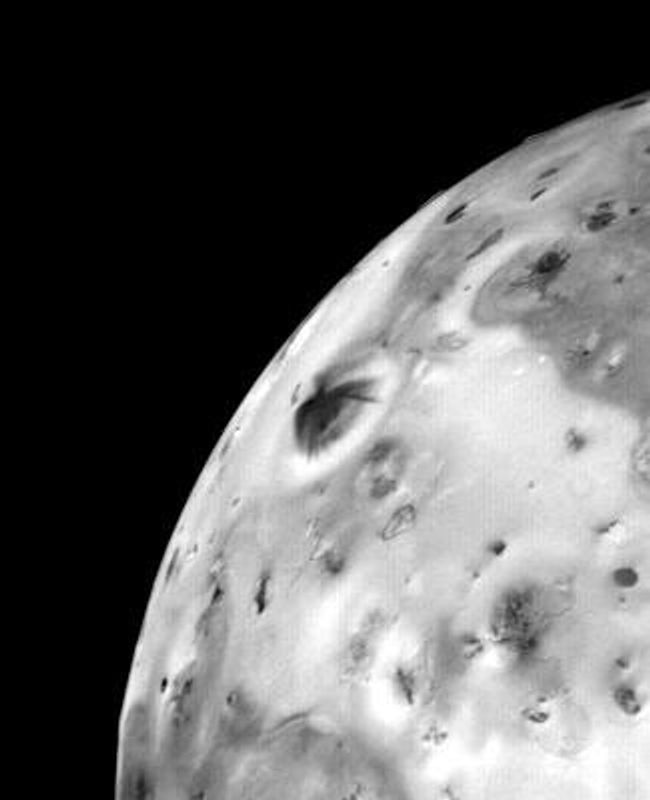
Voyager 1 photographed an eruption on Jupiter's moon Io in 1979. The image helped establish the first observed active volcanism beyond Earth.
2026-09-24 · NASA/JPL
What the image shows
Voyager 1 took this image on 4 March 1979, about twelve hours before its closest approach to Jupiter. A dark, fountain-shaped plume rises more than 100 kilometres above Io's edge. Its position above the limb shows material leaving the surface, rather than a dark marking on it.
How the finding was confirmed
Other images revealed further eruptions, while infrared measurements found unusually warm regions associated with volcanic activity. This was the first observation of an active eruption on another body in the Solar System. The result raised a new question: what keeps this small moon so energetic?
Why Io remains active
Jupiter's gravity, together with the pulls of Europa and Ganymede, keeps Io's orbit slightly elliptical. As Io travels around Jupiter it is repeatedly flexed, heating its interior. This tidal heating powers the volcanoes.