Voyager 2: position today, discoveries and mission story
From four giant planets to measuring interstellar space. Track Voyager 2's position, learn about its discoveries at Uranus and Neptune, and learn how the team maintains communication with the probe.
Profile expanded on 2 October 2026 · new sections verified against NASA/JPL primary sources
Where is Voyager 2 now?
The values are calculated from locally stored JPL Horizons state vectors. They are not live telemetry or figures copied from a news article.
Voyager 2
- From the Sun
- — AU
- Speed relative to the Sun
- — km/s
- Change in distance from Earth
- — km/s
- Signal to Earth
- —
- Round trip
- —
- Distance travelled today
- — km
- Relative to escape velocity
- —×
- Relativistic time difference
- — s
- Apparent magnitude of the Sun
- — mag
- Remaining Pu‑238
- — %
- Mission duration
- —
- Distance travelled since page load
- 0 km
- Launch
Calculation for current UTC. The position is interpolated from daily geometric JPL vectors; it is not direct telemetry.
Position and velocity use JPL Horizons; instrument status is a separate, manually verified record. Read the methodology · NASA/JPL — Horizons documentation
Two views of the Voyagers’ journey
Snapshot at
Direction on the sky
- Right ascension
- 20.160ʰ
- Declination
- -59.708°
- Constellation · IAU
- Pavo (Pav)
This all-sky map shows the direction from Earth’s centre to both spacecraft. The highlighted point is this Voyager. Right ascension increases to the left; declination is the angle above or below the celestial equator. This map does not determine visibility above your horizon.
Trajectories from the side
- X
- 39.915 au
- Y
- -105.518 au
- Z
- -89.769 au
Ecliptic plane · Z = 0
Looking along the X axis onto the Y–Z plane shows the trajectories relative to the Sun and the J2000 ecliptic plane. Both axes use the same linear scale in astronomical units. Straight segments connect trajectory samples; this is not a detailed view of planetary flybys.
How to read the maps and their data
Sky coordinates come directly from the JPL Horizons observer table: astrometric ICRF, with light travel time included. The side view uses geometric heliocentric vectors sampled every 60 days and an endpoint at the stated date. This is a dated ephemeris snapshot including predicted trajectory, not live telemetry. No extrapolation is used.
Three active science instruments
This assembly is documented by a NASA/JPL operational announcement dated August 4, 2026.
CRSCosmic Ray Subsystem
Measures very energetic particles in cosmic rays.
MAGMagnetometer
Measures the strength and direction of magnetic fields.
PWSPlasma Wave Subsystem
Records plasma waves in the interstellar environment.
The power change nicknamed “Big Bang” switched off selected powered devices and substituted lower-power alternatives while keeping the spacecraft warm enough. The saved power should keep CRS, MAG and PWS operating for at least one extra year beyond the previous expectation. It is an extension, not a guaranteed end date for the mission.
New information verified on 2 October 2026: NASA/JPL — Voyager 2: power saving from August 4, 2026.
Voyager 2 at a glance
- Launch
- 1977-08-20 · 14:29:44 UTC
- Launch site
- Cape Canaveral · Launch Complex 41
- Launch vehicle
- Titan IIIE-Centaur
- Spacecraft mass
- 721.9 kg
- Planetary targets
- Jupiter · Saturn · Uranus · Neptune
- Selected closest approach
- Uranus: 1986-01-24 · ~81,500 km
- Final planetary encounter
- Neptune: 1989-08-25 · ~4,800 km above clouds
- Heliopause
- 2018-11-05
- Active instruments
- CRS · MAG · PWS
- Mission status
- Extended mission · active
The route that completed the planetary Grand Tour
Voyager 2 launched on 20 August 1977. Its primary mission covered Jupiter and Saturn, but the trajectory preserved the option to continue. After the Saturn success, NASA authorised Uranus and later Neptune. Each encounter also acted as a gravity assist, changing direction and speed, making Voyager 2 the first and still only spacecraft to visit all four giant planets at close range.
Jupiter and Saturn opened the route outward
Voyager 2 approached Jupiter on 9 July 1979 at 22:29 UTC, about 645,000 kilometres away, extending observations of its atmosphere, moons and ring. It passed Saturn on 26 August 1981 at 01:21 UTC, roughly 101,000 kilometres away. Images clarified ring spokes and data suggested the A ring could be about 300 metres thick; the Saturn trajectory set the course for Uranus.
The first and only close exploration of Uranus
Voyager 2 passed about 81,500 kilometres from Uranus and had approximately 5.5 hours for its closest study. It discovered ten moons, two rings and a magnetic field tilted about 55 degrees from the rotation axis. Detailed images covered Miranda, Ariel, Umbriel, Titania and Oberon; the spacecraft came within roughly 28,260 kilometres of Miranda.
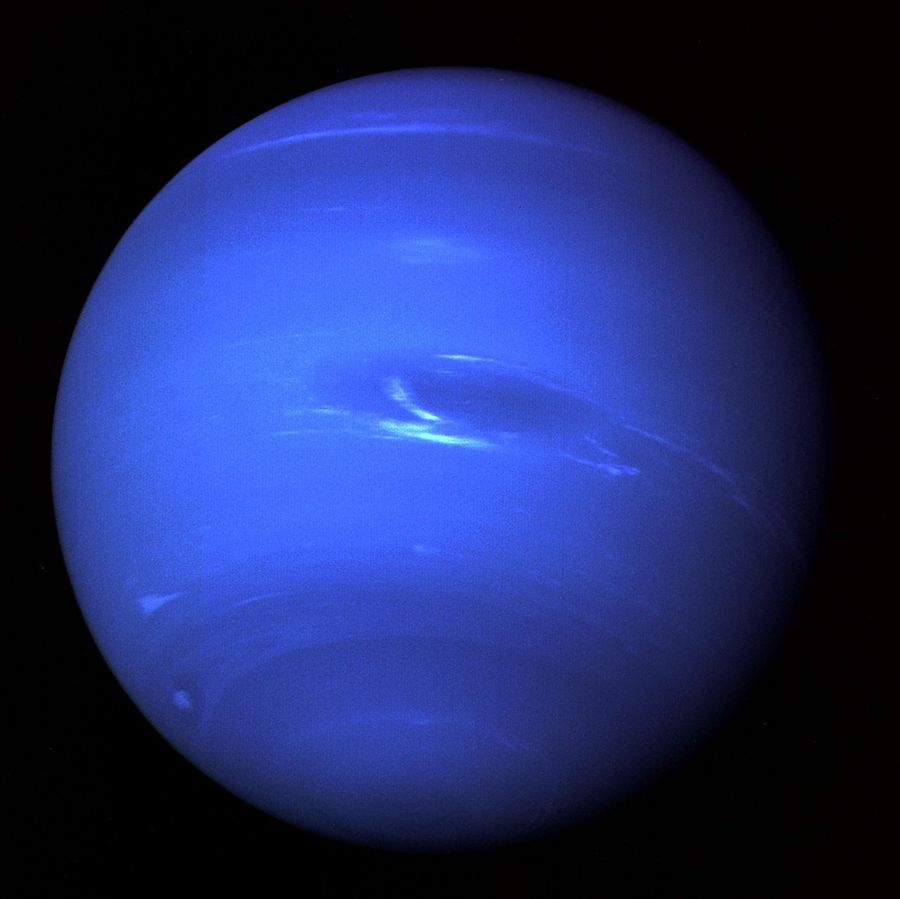
Neptune and Triton crowned the planetary mission
Voyager 2 passed only about 4,800 kilometres above Neptune’s cloud tops with all ten instruments still working. It discovered six moons and four rings, recorded the Great Dark Spot and winds around 1,100 kilometres per hour, and observed active nitrogen-ice plumes on Triton. The encounter completed a twelve-year planetary journey.
What the measurements changed
Uranus: a magnetic field measured up close
- Knowledge before the measurements
- Before the 1986 encounter, no spacecraft had explored Uranus at close range or measured its magnetic environment locally.
- Documented result
- Voyager 2 measured a magnetic field whose axis was strongly tilted relative to the rotation axis and offset from the planet’s centre.
- Scientific significance
- The measurements distinguished the planet’s magnetic geometry from its rotation geometry. The field could not be described by simply placing an aligned magnetic axis through the centre.
The moons of Uranus: known worlds seen up close
- Knowledge before the measurements
- Before Voyager’s observations, astronomers knew 5 moons of Uranus, including Miranda.
- Documented result
- Voyager 2 returned detailed images of those large moons and identified additional small moons. The images revealed different surface structures on the individual worlds.
- Scientific significance
- The encounter expanded the inventory and added surface evidence for geological studies. A visible landform is an observation; a proposed explanation of its origin requires further analysis.
Neptune: resolving the ring question
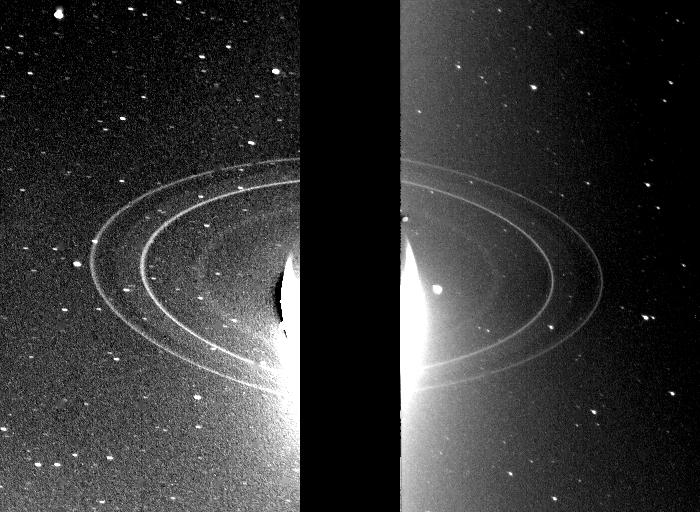
- Knowledge before the measurements
- Observations from Earth suggested dark rings or partial ring arcs, but the evidence was inconclusive.
- Documented result
- Voyager 2 photographed the rings directly. NASA’s mission summary states that they extend all the way around the planet. Their material is so sparse and fine that observations from Earth could not show their full extent clearly.
- Scientific significance
- The flyby distinguished a complete ring structure from the incomplete structures suggested by earlier observations. It provided direct images for subsequent study.
Evidence: NASA — 30 Years Ago: Voyager 2 Explores Neptune · NASA — Voyager Fact Sheet · NASA Photojournal — Rings of Neptune (PIA01997)
New material checked against primary sources ·
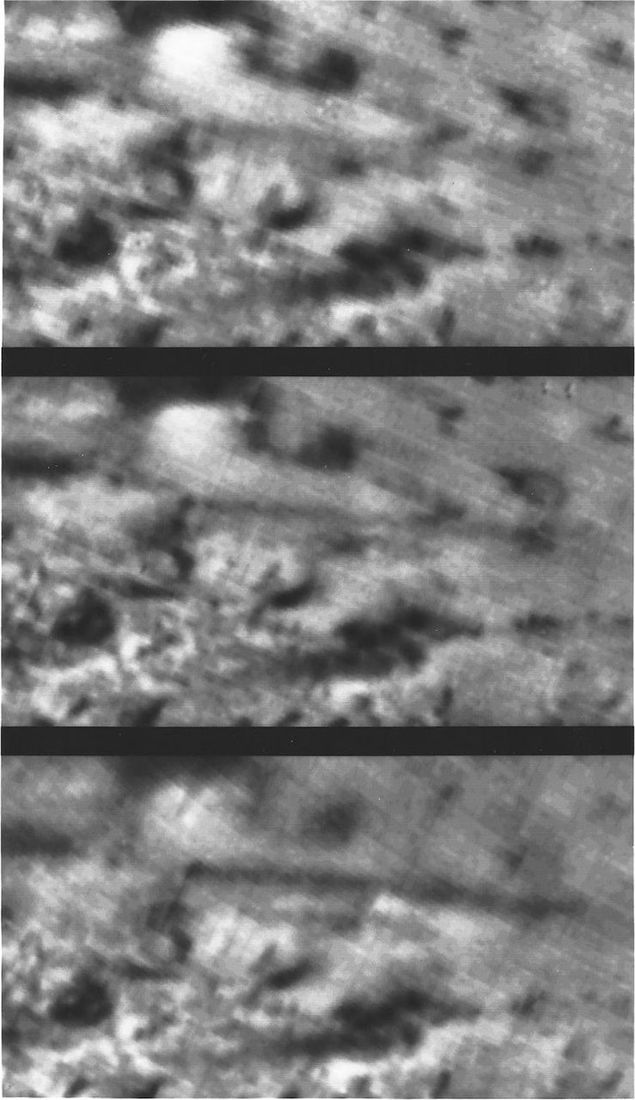
Triton: why three images tell us more than one
Triton photos provide evidence of activity on a distant icy moon. This trio captures a dark cloud rising above the surface and drifting in the thin atmosphere. In the last shot, even his shadow can be distinguished.
The time sequence allows you to follow the transformation of the formation. However, the appearance of a cloud alone does not determine the mechanism below the surface. The official description of NASA also notes that the apparent thickening of the cloud may be related to the change in viewing angle; it cannot be determined from the images whether its density has actually increased.
The interpretation therefore begins with what can be seen in the picture. A more detailed story also describes the proposed explanation for the jet and clearly labels it as a hypothesis. View the full story of Triton →
New information verified on 2 October 2026: NASA Photojournal — Triton's Volcanic Plumes (PIA14449).
A direct measurement of the heliopause crossing
After crossing the termination shock on 30 August 2007, Voyager 2 crossed the heliopause on 5 November 2018. Unlike Voyager 1, it still had a working PLS instrument, which measured a steep fall in solar-wind particle speed and then no further solar-wind flow. Together with other instruments, this provided direct evidence from a different direction through the heliosphere.
The same design, a different operating history
Voyager 2 shares the 3.7-metre antenna, three RTGs and redundant CCS, FDS and AACS computers. The original payload comprised ten instruments, or eleven investigations when radio science is counted. Identical construction did not produce identical histories: Voyager 2’s PLS worked until September 2024, while the equivalent instrument on Voyager 1 failed after Saturn.
Explore the spacecraft
Voyager 2 continued from Jupiter and Saturn to Uranus and Neptune. Its hardware had to support imaging during fast encounters and transmission over increasing distances. These examples connect the instrument layout with documented pointing, reception and power-management work.
Both Voyagers have the same basic design. This original NASA illustration identifies physical components; their roles in each mission are explained below. Follow a numbered marker to its description.
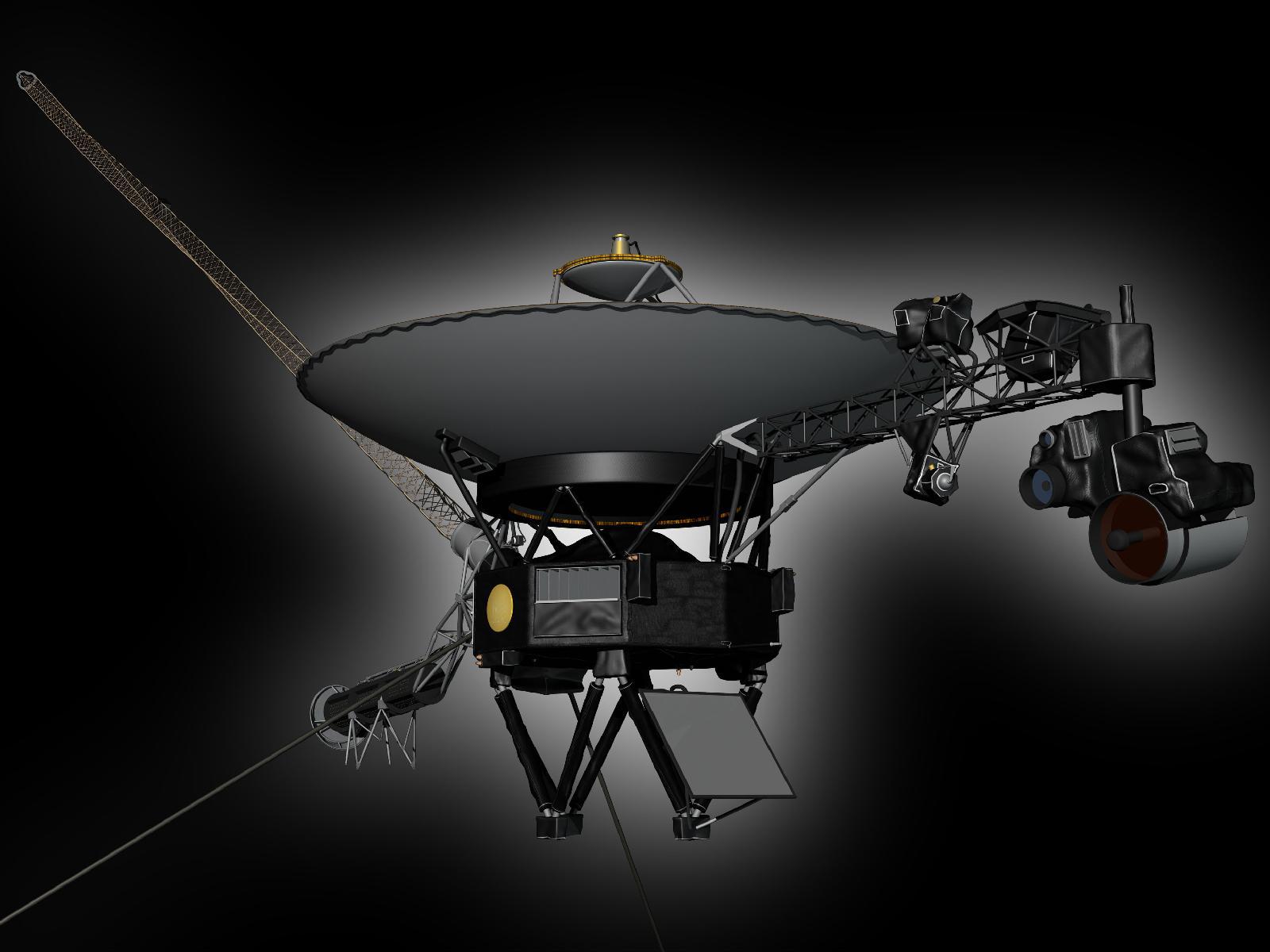
HGAMain communication antenna
The 3.7-metre dish carries commands and data between the spacecraft and Earth. The attitude-control system keeps it pointed toward Earth. The large dish is a communication component; the science antennas have a different role.
Evidence: NASA Photojournal — Model of Voyager (PIA14111) · NASA — Voyager Spacecraft
CCS · FDS · AACSBody and onboard electronics
The central body contains electronics compartments. Command handling, data processing and attitude control have separate computer systems. The command system includes fault-detection and corrective routines. The computers are inside the body, rather than individually visible in this illustration.
Evidence: NASA — Voyager Spacecraft
RTGRadioisotope power generators
A separate boom carries 3 radioisotope thermoelectric generators. They supply electricity using heat from radioactive decay. The available electrical power must be shared between instruments and engineering systems, including heating.
Evidence: NASA Photojournal — Model of Voyager (PIA14111) · NASA — Voyager Spacecraft
MAGBoom for magnetic measurements
The long boom places magnetic sensors away from interference produced by the spacecraft. This separation matters when measuring weak surrounding magnetic fields. The sensor placement is part of the measurement design.
Evidence: NASA Photojournal — Model of Voyager (PIA14111) · NASA — Basics of Space Flight: Science Instruments
ISS · UVS · IRIS · PPSInstrument boom and pointing platform
The right-hand assembly carries science instruments, including cameras and spectrometers. The movable platform aims remote observations. The camera system has narrow-angle and wide-angle cameras; filter measurements can be combined to produce colour images.
Evidence: NASA Photojournal — Model of Voyager (PIA14111) · NASA — Voyager Spacecraft
PWS · PRAAntennas for plasma waves
The thin rods belong to the plasma-wave and planetary-radio experiments. They detect electrical and radio phenomena around the spacecraft. Their scientific measurements complement the data from particle detectors and magnetic sensors.
Evidence: NASA Photojournal — Model of Voyager (PIA14111) · NASA — Voyager Spacecraft
How this hardware was used
Keeping Neptune’s images sharp in 1989
The weak sunlight at Neptune required longer camera exposures. Motion during an exposure could blur an image. Engineers programmed gentle thruster firings to rotate Voyager 2 and keep the camera aimed at its target. This was control of the spacecraft’s orientation for observation, distinct from selecting its interplanetary trajectory.
Evidence: JPL — Voyager 2’s Historic Neptune Flyby
Receiving the pictures on Earth
For the Neptune encounter, the Deep Space Network enlarged its largest antennas. Reception also used the Parkes dish in Australia and antennas of the Very Large Array in New Mexico. JPL documents that these improvements increased the data that could be returned, allowing more images from the encounter to reach Earth.
Evidence: JPL — Voyager 2’s Historic Neptune Flyby
Reallocating power in 2026
NASA reported a power-saving change called Big Bang on Voyager 2. Engineers switched off selected powered devices and used lower-power alternatives while keeping the spacecraft warm enough to operate. The announcement documented continued operation of 3 science instruments. It did not set a guaranteed final date for the mission.
Evidence: NASA — Engineers Help Prolong Voyager 2’s Science Mission (2026)
New material checked against primary sources ·
Where Voyager 2 is heading
Voyager 2 escapes at about 3.1 AU per year, roughly 48 degrees south of the ecliptic toward Sagittarius and Pavo. In about 40,000 years it is expected to pass around 1.7 light-years from the small star Ross 248 in Andromeda. This is the continuation of its escape trajectory after Neptune, not a controlled mission target.