Golden Record
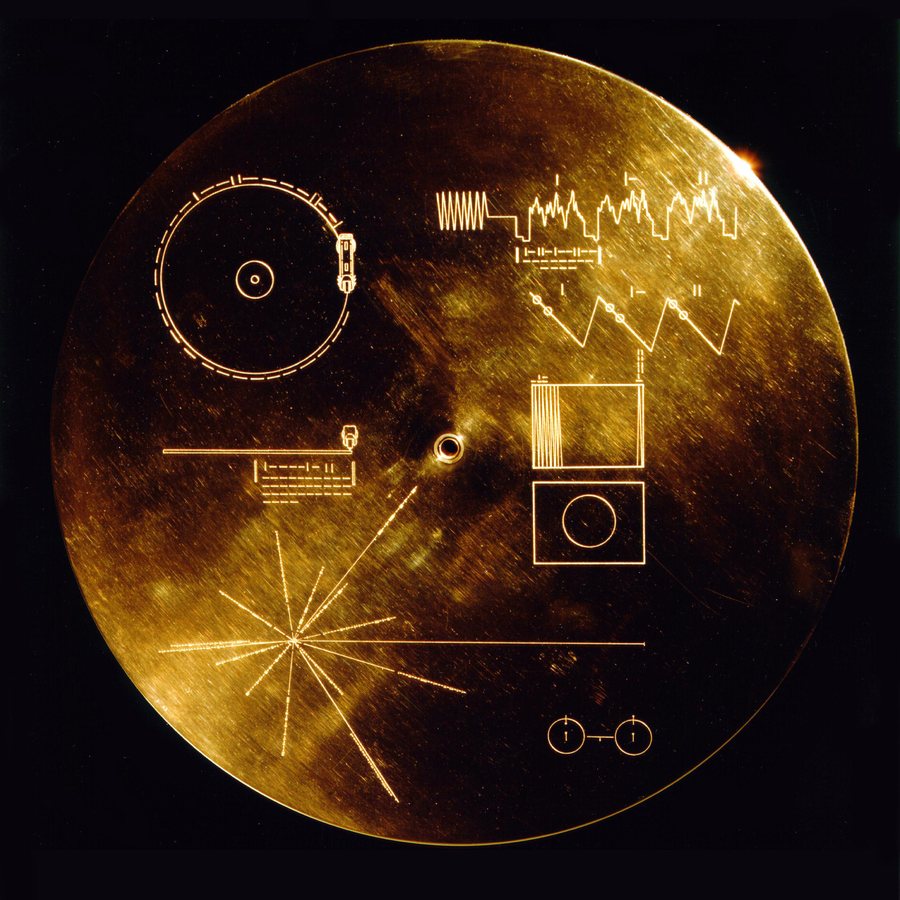
A gold-plated copper disc aboard both spacecraft carries an audio-visual portrait of Earth — together with instructions for playing it and identifying its origin.
Credit: NASA/JPL-Caltech
A time capsule
The 30-centimetre record was made for both spacecraft. A committee chaired by Carl Sagan selected natural sounds, greetings in 55 languages, music from several traditions and images describing Earth and life.
How to read the cover
The diagrams use the neutral-hydrogen transition as a universal unit of time, explain how to reproduce an analogue image and locate the Sun relative to pulsars. A layer of uranium-238 serves as a very long-term time marker.
What is deliberately not hosted here
We do not host copyrighted music or photographs from the record. NASA notes that many images belong to third parties, so we provide descriptions and a link to the official catalogue.
Official NASA catalogue
How to read the symbols on the cover
The cover combines instructions for playback, image reconstruction and recording origin determination. The numbers in our image connect the individual drawings with the explanation below. Each tag can also be opened using the keyboard.
Playing a disc
The upper left drawing shows the plate and needle. The record is read from the outer edge inwards. Binary notation gives 3.6 seconds per revolution; the drawing below shows a side view.
From signal to image
In the upper right is the signal progression and the order of the picture lines. The full image has 512 of vertical lines. The scheme determines their folding into a grid.
Circle as control
The first image contains a circle. With the right ratio of width and height, it will be restored as a circle; stretching indicates incorrect image assembly.
Origin map
The drawing on the lower left shows the position of the Solar System relative to the 14 pulsars and their periods.
Common unit of time
The two connected drawings on the lower right represent the two states of the hydrogen atom. The transition between them provides a unit of time for both the inscriptions on the cover and the images.
Verified on 2 October 2026: NASA — Golden Record Cover.
More information is in the material itself
Disc consists of gold-plated copper; the protective cover is aluminum. There is also a sample of uranium-238 on the cover. By measuring the ratio of this isotope and its decay products, the eventual finder could determine the time since the sample was deposited. This information complements the engraved instructions and the pulsar map.
Numerical signs belong to our interpretation. The original symbols remain visible in the archive photo; the individual steps of the manual can be compared with the detailed description of NASA given in the sources.
Verified on 2 October 2026: NASA — Making of the Golden Record · NASA — Golden Record Cover.