Voyager power and RTGs
Three radioisotope generators on each spacecraft convert heat from plutonium-238 decay into electricity, while available output continuously declines.
Facts verified 30 Aug 2026 · NASA — Voyager Spacecraft ↗
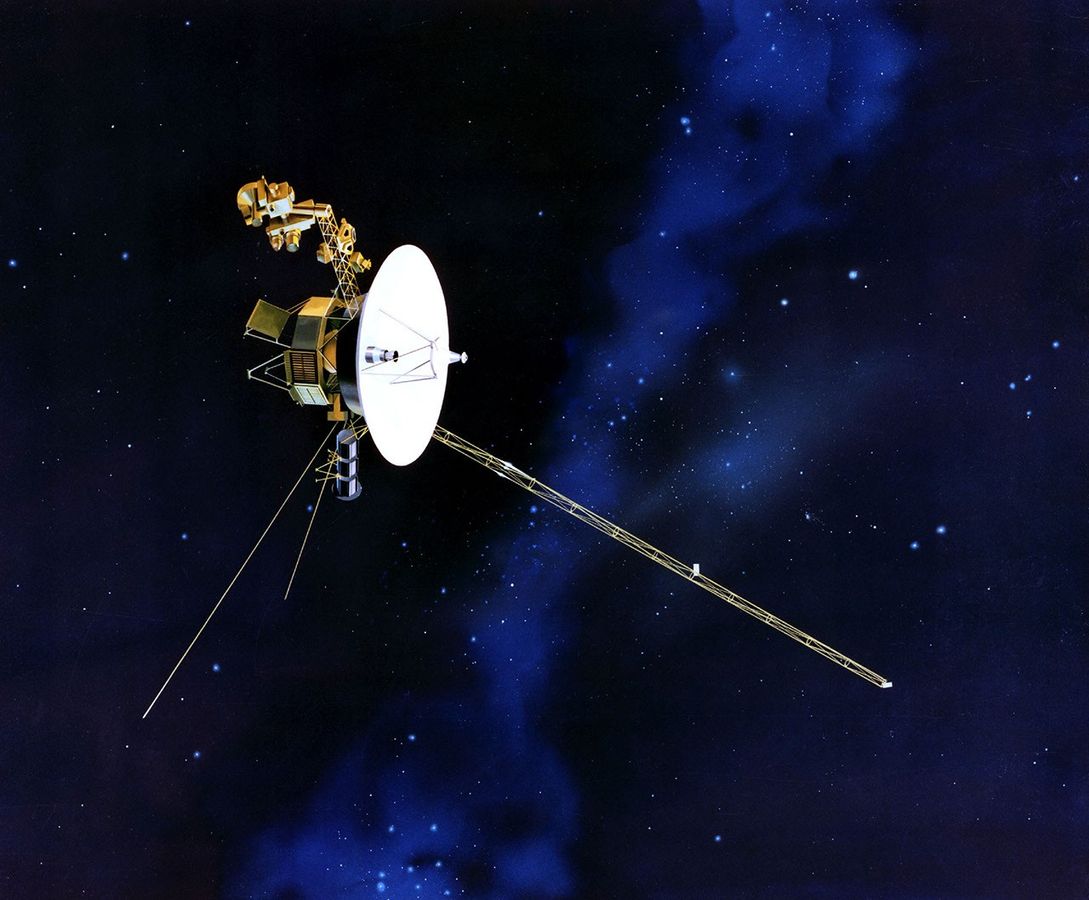
Why Voyager does not use solar arrays
Sunlight becomes far weaker with distance. A mission designed for Jupiter and Saturn needed power independent of illumination, so NASA selected radioisotope thermoelectric generators. An RTG is not a nuclear reactor: natural radioactive decay supplies heat, and thermoelectric elements convert part of that heat into electricity.
Evidence: NASA — Voyager Fact Sheet ↗ · NASA — Voyager Spacecraft ↗
Plutonium-238 heat with no moving parts
Each Voyager carries three electrically parallel RTGs mounted on a boom. Their plutonium-238 oxide heat sources power instruments, computers, radio, heaters and engineering systems. The lack of moving generator parts supports long unattended operation, but neither the isotope nor the converter can maintain constant output forever.
Evidence: NASA — Voyager Spacecraft ↗
About four watts less available each year
Current NASA/JPL operations updates say each spacecraft loses roughly four watts of available electrical power per year. This is not identical to the fraction of plutonium remaining: electrical output reflects the complete heat-source and conversion system. Demand must remain below supply with a safety margin.
Evidence: NASA — Voyager Science ↗ · NASA/JPL — Voyager 1 status, 2026-04-17 ↗ · NASA/JPL — Voyager 2 status, 2026-08-04 ↗
Shutting down loads without freezing the spacecraft
The team follows a planned order for switching off heaters, instruments and other loads while protecting essential communication, computing and attitude control. Fuel lines must not become too cold. As verified on 30 August 2026, Voyager 1 operates MAG and PWS, while Voyager 2 retains CRS, MAG and PWS. Exact mission-end dates remain uncertain.
Evidence: NASA — Voyager Science ↗ · NASA — Voyager FAQ ↗ · NASA/JPL — Voyager 1 status, 2026-04-17 ↗ · NASA/JPL — Voyager 2 status, 2026-08-04 ↗
Related topics
These guides use the same evidence rules and primary sources.
Voyager’s onboard computers
The six onboard computers, CCS, FDS and AACS, their memory, assembly language, fault protection and spacecraft time.
Open article →How Voyager communicates with Earth
How NASA sends commands to Voyager and receives data through the Deep Space Network, radio bands, data rates and signal delay.
Open article →Where the Voyagers are heading
Escape trajectories, directions, future stellar approaches, the Oort Cloud and the uncertain future of communications.
Open article →Article sources
Factual statements use the NASA and JPL primary sources below. Changing operational facts are dated.