Where the Voyagers are heading
The spacecraft continue on escape trajectories in different directions. The stars they may pass are predictions, not mission targets.
Facts verified 30 Aug 2026 · NASA — Voyager FAQ ↗
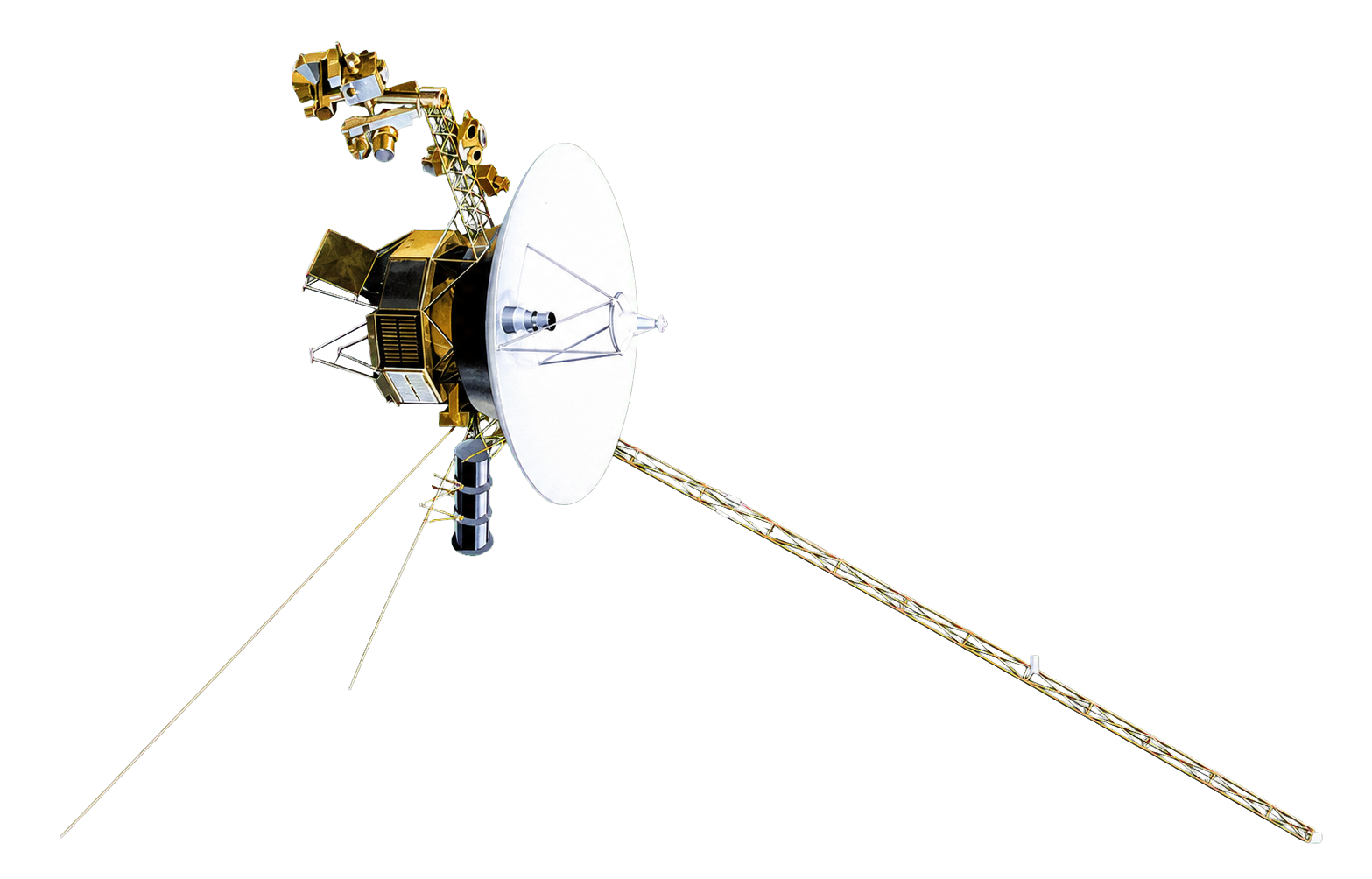
They will not return to the Sun
Planetary flybys placed both spacecraft on paths with enough energy to escape the Sun. They mostly coast rather than continuously accelerate; small thrusters control attitude and make minor corrections. Physical flight continues even after electrical power and communication eventually cease.
Evidence: NASA — Voyager FAQ ↗ · NASA — Spacecraft Navigation ↗
North of the ecliptic toward Ophiuchus
NASA lists an escape rate near 3.5 AU per year, about 35 degrees north of the ecliptic. In the year 40,272 Voyager 1 is predicted to pass about 1.7 light-years from AC+79 3888. This is not a targeted encounter.
Evidence: NASA — Voyager FAQ ↗ · NASA — Voyager 1 ↗
South of the ecliptic toward Sagittarius and Pavo
Voyager 2 escapes at about 3.1 AU per year and 48 degrees south of the ecliptic. In roughly 40,000 years it should pass about 1.7 light-years from Ross 248 in Andromeda. This too is simply the continuation of its post-Neptune path.
Evidence: NASA — Voyager FAQ ↗ · NASA — Voyager 2 ↗
Oort Cloud, ephemerides and the final signal
NASA estimates about 300 years for Voyager 1 to reach the inner Oort Cloud and perhaps 30,000 years to cross it. This website does not extrapolate beyond its JPL Horizons dataset. Communication depends on diminishing power and ageing hardware, so operations updates can extend expectations but cannot guarantee an exact final-contact date.
Evidence: NASA — Voyager FAQ ↗ · NASA/JPL — Horizons documentation ↗ · NASA/JPL — Voyager 1 status, 2026-04-17 ↗ · NASA/JPL — Voyager 2 status, 2026-08-04 ↗
Related topics
These guides use the same evidence rules and primary sources.
The heliosphere and interstellar space
Termination shock, heliosheath and heliopause, how the Voyagers detected the crossing and why they have not left the entire Solar System.
Open article →How Voyager communicates with Earth
How NASA sends commands to Voyager and receives data through the Deep Space Network, radio bands, data rates and signal delay.
Open article →The Voyager Grand Tour
The outer-planet alignment, gravity assists and different Voyager 1 and 2 trajectories that enabled four giant-planet encounters.
Open article →Article sources
Factual statements use the NASA and JPL primary sources below. Changing operational facts are dated.