Voyager’s onboard computers
Each spacecraft carries three specialised computer types in redundant pairs, separating commands, science data and attitude control.
Facts verified 30 Aug 2026 · NASA — Voyager FAQ ↗
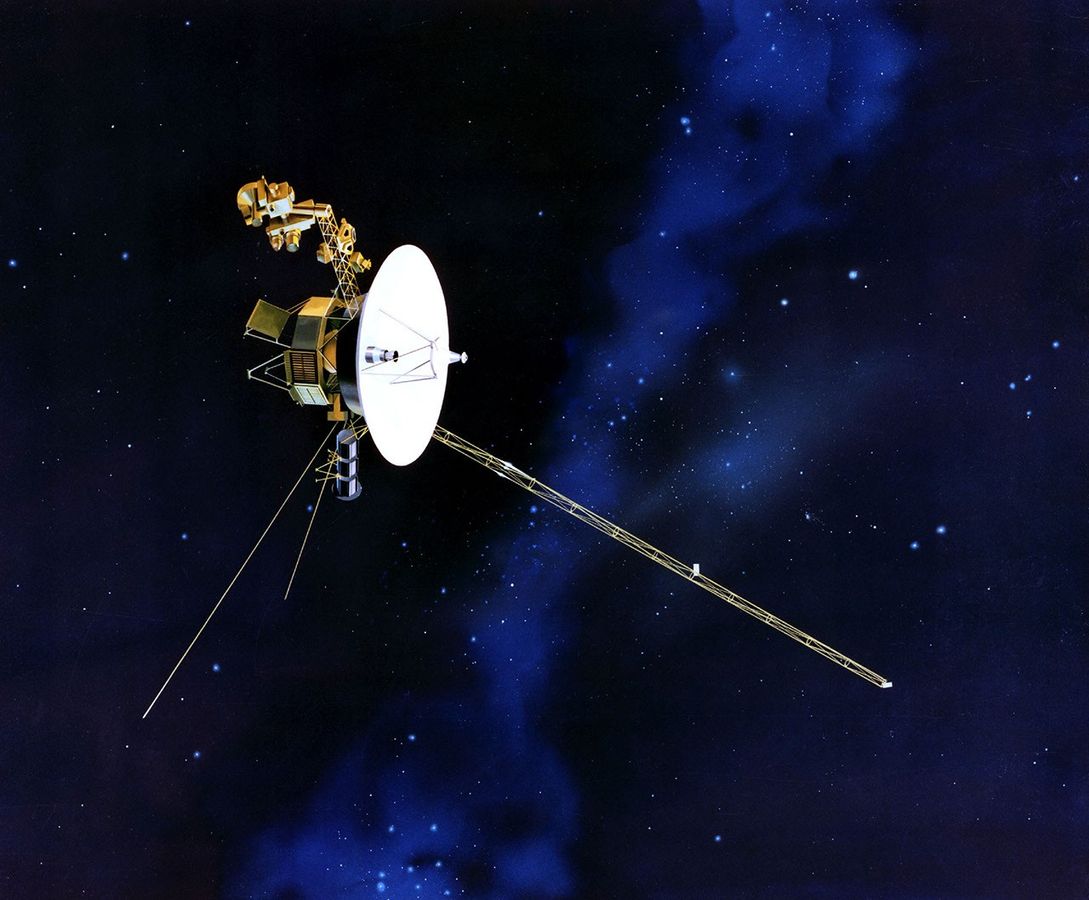
Three computer types, two of each
NASA describes six computers: two CCS, two FDS and two AACS units. They are specialised rather than interchangeable general-purpose machines. Together they contain about 32,000 memory words using 16-bit and 18-bit architectures. Quoting the original word count avoids a misleading conversion to modern byte-based memory.
Evidence: NASA — Voyager FAQ ↗
Commands, protection and science data
The Computer Command System decodes ground commands, runs stored sequences and contains fault-detection and corrective routines. The Flight Data System operates science instruments, collects and formats engineering and science data, and maintains the onboard time counter and frequency references.
Evidence: NASA — Voyager FAQ ↗ · NASA — Voyager Spacecraft ↗
Keeping the antenna pointed at Earth
The Attitude and Articulation Control System controls orientation and maneuvers and keeps the high-gain antenna pointed toward Earth. It uses celestial or gyro references and small thrusters. NASA lists two 18-bit AACS machines with 4,096 words each.
Evidence: NASA — Voyager FAQ ↗
A programmed response before Earth can answer
Voyager processes roughly 8,000 instructions per second and uses interrupt-driven assembly-language software. Because radio delay lasts many hours, programmed fault protection can detect selected conditions and place the spacecraft in a safer state. This is a defined set of rules and recovery sequences, not general artificial intelligence.
Evidence: NASA — Voyager Science ↗ · NASA — Voyager technical facts ↗
Related topics
These guides use the same evidence rules and primary sources.
How Voyager communicates with Earth
How NASA sends commands to Voyager and receives data through the Deep Space Network, radio bands, data rates and signal delay.
Open article →Voyager power and RTGs
How Voyager converts radioactive heat to electricity, why it has no solar arrays and how NASA budgets every watt.
Open article →How Voyager navigation works
Reference trajectories, DSN Doppler and ranging, attitude control, trajectory corrections and gravity assists.
Open article →Article sources
Factual statements use the NASA and JPL primary sources below. Changing operational facts are dated.