How Voyager communicates with Earth
A command can spend almost a day travelling to the spacecraft. The reply returns through the same network as an exceptionally weak radio signal.
Facts verified 30 Aug 2026 · NASA — Voyager Spacecraft ↗
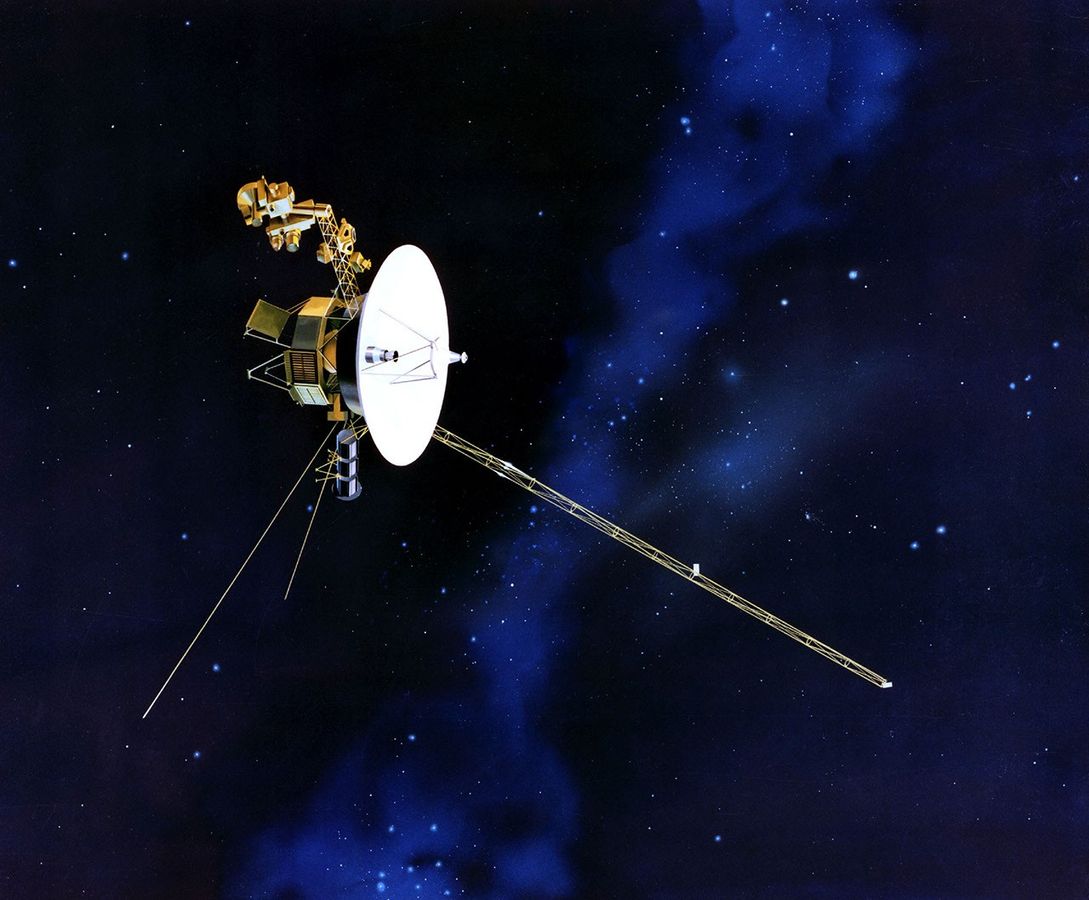
Communication is not a telephone call
The flight team validates command sequences before a Deep Space Network station transmits them toward the predicted spacecraft position. Voyager decodes and executes the sequence, then returns engineering or science telemetry. The long light time prevents immediate intervention, so a command, its execution and confirmation form a delayed operational cycle.
Evidence: NASA — Voyager Spacecraft ↗ · JPL — Voyager Telecommunications ↗
Three complexes around Earth
DSN complexes in California, Spain and Australia provide global coverage as Earth rotates. The network sends commands, receives telemetry and measures Doppler shift and signal travel time. Navigation teams use those measurements to estimate velocity and range and to prepare antenna-pointing and frequency predictions.
Evidence: NASA — Voyager Fact Sheet ↗ · NASA — Deep Space Network tracking and telemetry ↗
A 3.7-metre antenna and S/X bands
Voyager receives S-band commands at 16 bits per second. NASA lists a normal X-band telemetry rate around 160 bits per second and 1.4 kilobits per second for selected plasma-wave playback. Precise pointing, large ground antennas, stable frequency references and coding make recovery of the extremely weak signal possible.
Evidence: NASA — Voyager Spacecraft ↗ · JPL — Deep Space Network science ↗
Telemetry, tracking and the website calculator
Telemetry contains spacecraft health and science measurements. Tracking data comes from the radio link itself and helps determine the trajectory. This website does not show a live packet: it computes position and light time from local JPL Horizons state vectors. Continued contact depends on transmitter power and hardware condition, so no exact final-contact date is guaranteed.
Evidence: NASA — Deep Space Network tracking and telemetry ↗ · NASA — Voyager FAQ ↗ · NASA/JPL — Horizons documentation ↗
Related topics
These guides use the same evidence rules and primary sources.
Voyager’s onboard computers
The six onboard computers, CCS, FDS and AACS, their memory, assembly language, fault protection and spacecraft time.
Open article →How Voyager navigation works
Reference trajectories, DSN Doppler and ranging, attitude control, trajectory corrections and gravity assists.
Open article →Where the Voyagers are heading
Escape trajectories, directions, future stellar approaches, the Oort Cloud and the uncertain future of communications.
Open article →Article sources
Factual statements use the NASA and JPL primary sources below. Changing operational facts are dated.