Voyager discoveries at the planets
The twin spacecraft revealed dynamic planetary systems of rings, atmospheres, magnetic fields and active moons.
Facts verified 30 Aug 2026 · NASA — Voyager Fact Sheet ↗
A shared mission with different opportunities
Both spacecraft were built for Jupiter and Saturn. Voyager 1 prioritised a close Titan flyby and then left the planetary plane. Voyager 2 preserved the route to Uranus and Neptune. Their results therefore complement rather than duplicate one another.
Evidence: NASA — Voyager Fact Sheet ↗ · NASA — Voyager Planetary Voyage ↗
A faint ring, new moons and active Io
Voyager 1 revealed Jupiter’s faint ring and discovered Thebe and Metis. The mission’s greatest surprise was active volcanism on Io, the first observed active volcanoes beyond Earth. Voyager 2 extended the atmospheric and moon observations several months later.
Evidence: NASA — Voyager 1 ↗ · NASA — Voyager 2 ↗ · NASA — Voyager FAQ ↗
A dynamic ring system and a hidden surface
The spacecraft resolved fine ring structures, spokes and shepherding moons. Voyager 1 found five moons and the G ring. Titan’s dense nitrogen-rich atmosphere containing methane and hydrocarbons hid its surface and made the close encounter a major scientific priority.
Evidence: NASA — Voyager 1 ↗ · NASA — Voyager 2 ↗ · NASA — Voyager Fact Sheet ↗
The only close observations of the two ice giants
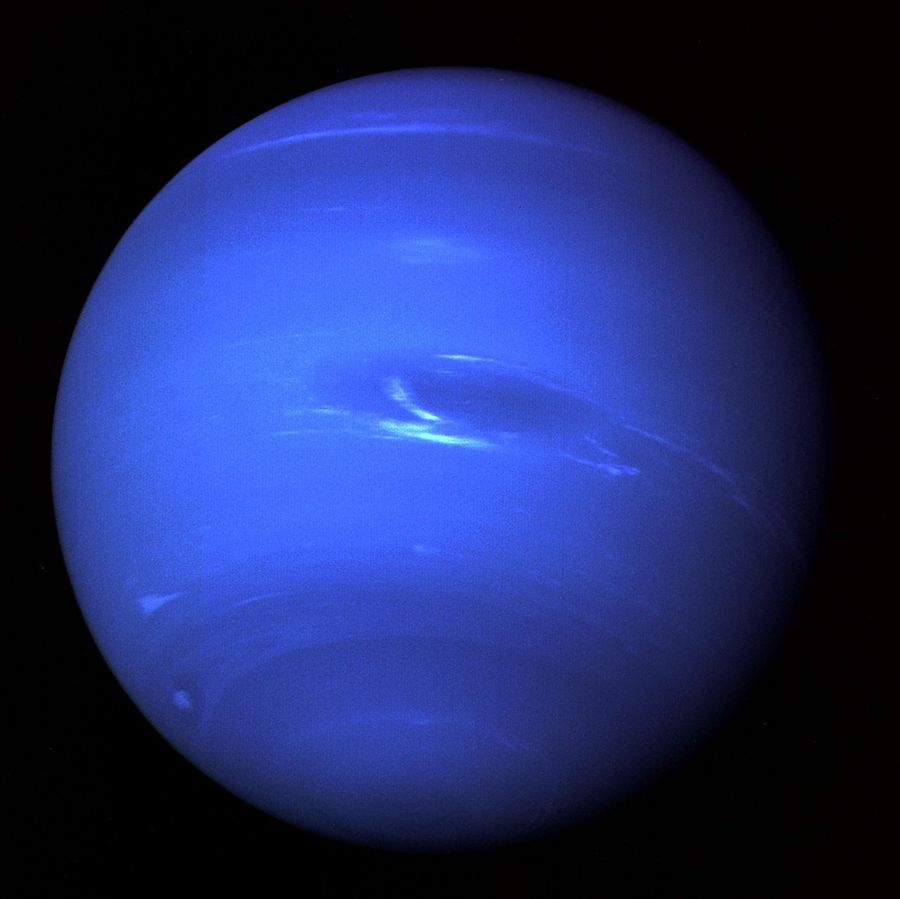
Voyager 2 discovered ten Uranian moons, two rings and a magnetic field tilted about 55 degrees. At Neptune it discovered six moons and four rings, recorded the Great Dark Spot and winds around 1,100 km/h, and observed active nitrogen-ice plumes on Triton.
Evidence: NASA — Voyager 2 ↗
Related topics
These guides use the same evidence rules and primary sources.
The Voyager Grand Tour
The outer-planet alignment, gravity assists and different Voyager 1 and 2 trajectories that enabled four giant-planet encounters.
Open article →The heliosphere and interstellar space
Termination shock, heliosheath and heliopause, how the Voyagers detected the crossing and why they have not left the entire Solar System.
Open article →How Voyager navigation works
Reference trajectories, DSN Doppler and ranging, attitude control, trajectory corrections and gravity assists.
Open article →Article sources
Factual statements use the NASA and JPL primary sources below. Changing operational facts are dated.