The Voyager Grand Tour
Planetary geometry and gravity assists allowed Voyager 2 to visit all four giant planets in twelve years.
Facts verified 30 Aug 2026 · NASA — Voyager Fact Sheet ↗
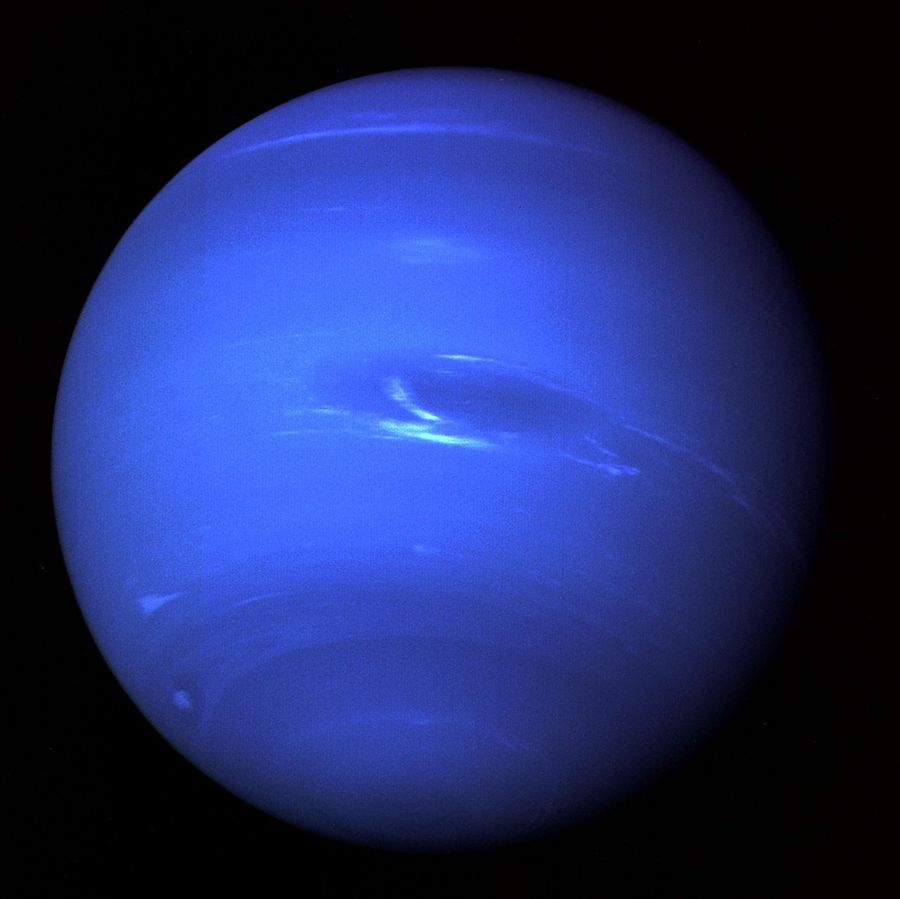
Four complex spacecraft became two Voyagers
The original Grand Tour concept used four highly complex spacecraft for five outer planets. NASA cancelled it in January 1972 largely because of expected cost and approved two spacecraft for Jupiter and Saturn. Their design and trajectories nevertheless preserved a possible extension.
Evidence: NASA — Voyager 2 ↗ · NASA — Voyager Fact Sheet ↗
Every planet had to be in the correct place
A gravity-assist chain only works when arrival at each planet leads toward the next target. The 1977 launch opportunity connected Jupiter, Saturn, Uranus and Neptune. The mission therefore depended on timing and geometry, not simply on a more powerful launch vehicle.
Evidence: NASA — Voyager Planetary Voyage ↗ · NASA — Trajectories and Gravity Assists ↗
Titan for Voyager 1, the outer planets for Voyager 2
Voyager 1 took the faster Jupiter–Saturn route and a high-priority Titan flyby that sent it above the planetary plane. Voyager 2 passed Saturn at a point leading to Uranus; after success, NASA authorised Uranus and then Neptune.
Evidence: NASA — Voyager Fact Sheet ↗ · NASA — Voyager 1 ↗ · NASA — Voyager 2 ↗
Jupiter, Saturn and Uranus prepared the next encounter
Each flyby exchanged a minute amount of momentum with the orbiting planet and changed the spacecraft’s heliocentric route. Jupiter sent both Voyagers toward Saturn; Saturn and Uranus continued Voyager 2 to Neptune. NASA says the assists reduced travel time to Neptune by nearly twenty years compared with an unassisted route.
Evidence: NASA — Gravity Assist Primer ↗ · NASA — Voyager technical facts ↗ · NASA — Voyager 2 ↗
Related topics
These guides use the same evidence rules and primary sources.
How Voyager navigation works
Reference trajectories, DSN Doppler and ranging, attitude control, trajectory corrections and gravity assists.
Open article →Voyager discoveries at the planets
Volcanoes on Io, Saturn’s rings and Titan, Uranus’s moons and magnetic field, Neptune and Triton.
Open article →Where the Voyagers are heading
Escape trajectories, directions, future stellar approaches, the Oort Cloud and the uncertain future of communications.
Open article →Article sources
Factual statements use the NASA and JPL primary sources below. Changing operational facts are dated.