How Voyager navigation works
Navigation combines a planned trajectory, radio tracking of the actual path and small thruster corrections while the antenna remains pointed at Earth.
Facts verified 30 Aug 2026 · NASA — Spacecraft Navigation ↗
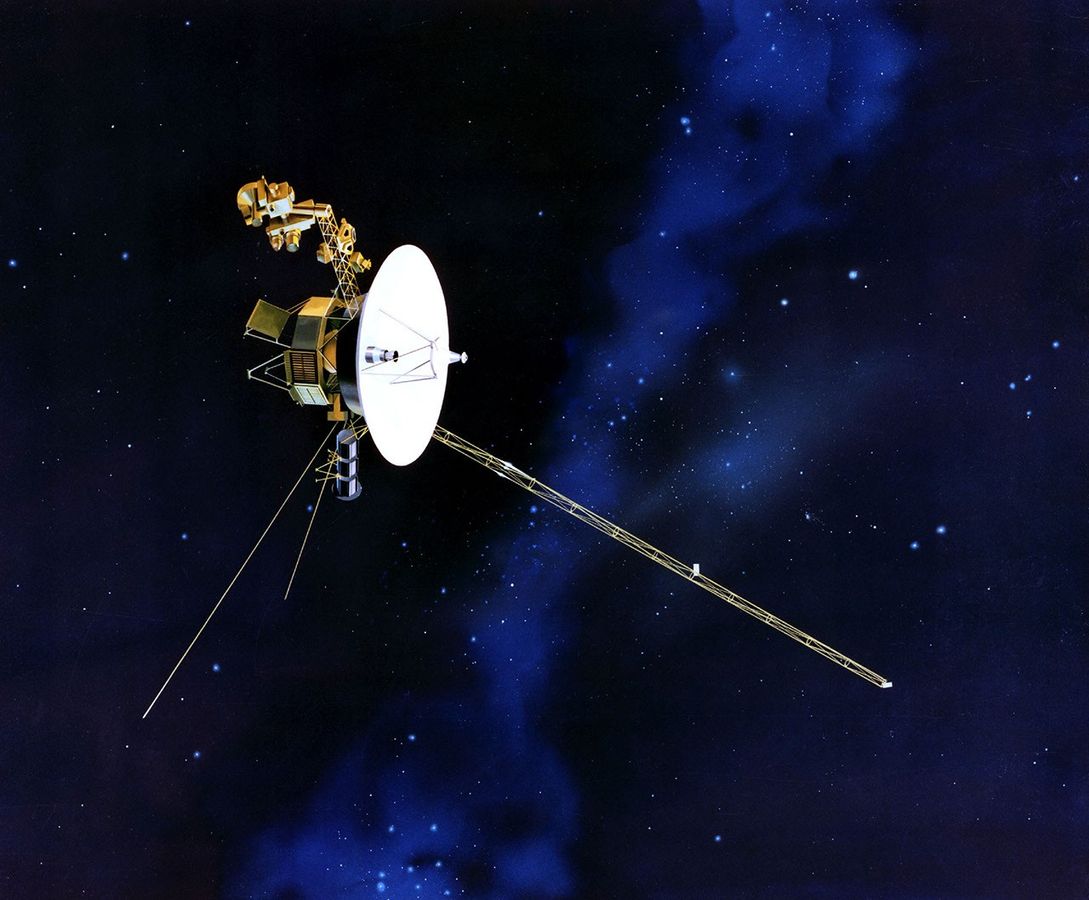
Design, orbit determination and flight-path control
NASA divides navigation into designing a reference trajectory, determining where the spacecraft actually is and planning maneuvers to correct deviations. Gravity, sunlight pressure and small maneuver errors continually alter the real path, so measurement and prediction repeat throughout the mission.
Evidence: NASA — Spacecraft Navigation ↗
Doppler measures velocity and ranging measures distance
DSN observes the stable radio carrier. Doppler shift provides line-of-sight velocity, while transponded ranging tones provide distance. Data from different stations and times, together with accurate station positions and time references, support a three-dimensional trajectory estimate and pointing predictions.
Evidence: NASA — Deep Space Network tracking and telemetry ↗ · NASA — Spacecraft Navigation ↗
Pointing is not the same as position
AACS uses celestial or gyro references and small thrusters to keep the high-gain antenna toward Earth. A rotation changes spacecraft attitude without greatly changing its solar orbit. A trajectory correction maneuver deliberately changes velocity; DSN then measures the result and the navigation model is updated.
Evidence: NASA — Voyager Spacecraft ↗ · NASA — Voyager technical facts ↗
Planets changed the route; Horizons displays it
Voyager 2 used Jupiter, Saturn and Uranus to reach Neptune, exchanging a tiny amount of momentum with each orbiting planet. NASA says the assists shortened the Neptune journey by nearly twenty years. This website interpolates published JPL Horizons vectors for education; it is not the operational navigation system and sends no commands.
Evidence: NASA — Spacecraft Navigation ↗ · NASA — Trajectories and Gravity Assists ↗ · NASA — Gravity Assist Primer ↗ · NASA/JPL — Horizons documentation ↗
Related topics
These guides use the same evidence rules and primary sources.
How Voyager communicates with Earth
How NASA sends commands to Voyager and receives data through the Deep Space Network, radio bands, data rates and signal delay.
Open article →The Voyager Grand Tour
The outer-planet alignment, gravity assists and different Voyager 1 and 2 trajectories that enabled four giant-planet encounters.
Open article →Where the Voyagers are heading
Escape trajectories, directions, future stellar approaches, the Oort Cloud and the uncertain future of communications.
Open article →Article sources
Factual statements use the NASA and JPL primary sources below. Changing operational facts are dated.