Decode the Pioneer plaque
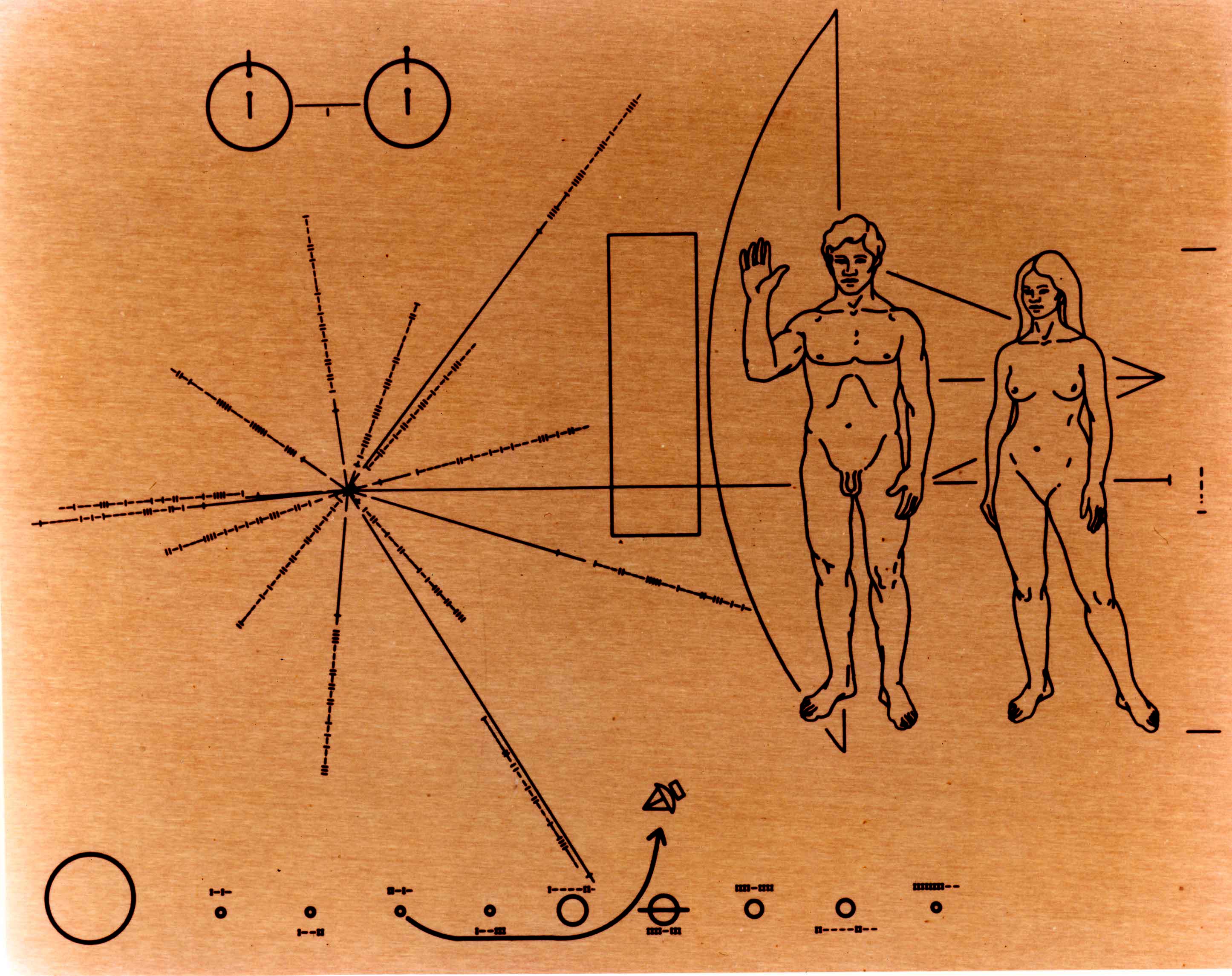
Study the engraving, guess what each of the four features means, and then open the explanations.
Two circles at the top left. What links them?
They show two states of a hydrogen atom. The transition between them has a characteristic wavelength of about 21 cm. The plaque uses that wavelength as a unit of length a reader could derive from physics.
Lines radiating from a point. What do the marks say?
The pattern locates the Sun relative to 14 pulsars and the direction to the centre of the Galaxy. Binary marks along the lines record the pulsar periods, providing a way to identify each source.
Two people. How can a reader work out their size?
The outline of the spacecraft behind them gives a reference they can compare with the actual probe. The binary marks beside the woman also give her height as eight hydrogen wavelengths.
A row of worlds at the bottom. Where does the arrow start?
It starts at the third planet from the Sun. The curved line passes Jupiter and shows Pioneer 10’s route out of the Solar System.
The same map, a different way to read
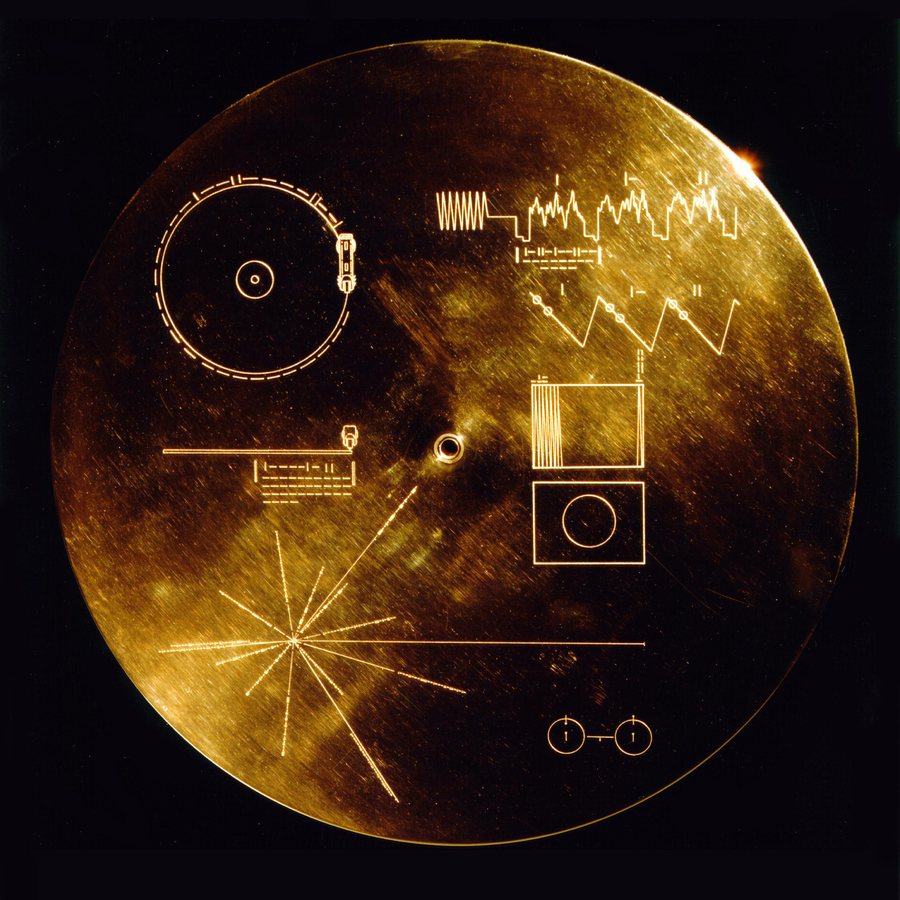
Voyager reused the pulsar map and the reference to hydrogen. The cover adds instructions for placing the stylus, spinning the record at the right rate and reconstructing a picture from the stored signal. The first test image is a circle, which lets a reader check the aspect ratio.
The record itself carries greetings in 55 languages, music, sounds of Earth and 115 images. The plaque can be read directly, while the record sets an extra challenge: build or emulate a player.
Explore the contents of the Golden Record →